
I have seen many B2B teams treat revenue as a sales number first and a systems problem second. That usually ends badly. Deals close, invoices go out, cash arrives late, and leaders wonder where the gap came from. This is where revenue cycle analytics starts to matter. It connects pipeline, billing, collections, renewals, and forecasting into one view.
Revenue cycle analytics helps B2B teams see how revenue moves from first touch to cash collection, and where that flow breaks.
In my experience, this matters far beyond finance. SaaS operators use it to judge pipeline quality. Strategy teams use it to test pricing and market moves. Investment teams use it to spot hidden weakness before a deal or board decision. At ZenitData.com, this is close to the real work of market intelligence and revenue analytics: turning scattered signals into structured answers for high-stakes decisions.
What it means in B2B
Many people hear this topic and think of healthcare billing. I think that is too narrow. In B2B, the revenue cycle covers lead creation, deal progression, contracting, invoicing, collections, expansion, and renewal. Every step creates data. Every step can also create leakage.
For a SaaS company, I would map the cycle like this:
- Marketing and outbound create demand
- Sales qualifies and converts pipeline
- Finance issues invoices and tracks receivables
- Customer success protects renewals and expansion
- Leadership forecasts cash, margin, and growth risk
If those teams work from different systems, the company loses speed and trust in the numbers. I have seen teams spend days reconciling CRM data with billing records, only to learn that a “closed won” deal had a delayed start date and no cash impact this quarter.
Revenue is a process, not an event.
KPIs that actually matter
I think the best metrics are the ones that connect operating activity to cash outcomes. Some terms need a B2B translation, especially when readers know them from healthcare settings.
Accounts receivable shows how much billed revenue is still unpaid, and how long cash is staying out of reach.
Days sales outstanding is often the faster signal, but accounts receivable aging tells the story in more detail. If older balances are rising, you may have weak collections, disputed invoices, or poor contract terms.
Cash flow forecasting estimates when booked and expected revenue will turn into actual cash.
This is where sales, finance, and strategy should meet. A forecast based only on bookings is often too optimistic. A stronger version adjusts for payment terms, implementation delays, churn risk, and collection patterns.
Claim denials also need translation for non-healthcare teams. In B2B, I use the term to mean rejected or blocked revenue events: invoices disputed by customers, payments delayed due to procurement errors, credits raised after pricing confusion, or contracts stuck in legal review. These are denials of expected revenue, even if they look different from insurance claims.
Other high-value KPIs include:
- Win rate by segment, channel, and pricing tier
- Average sales cycle length
- Pipeline coverage and stage conversion
- Discount rate and price realization
- Renewal rate and net revenue retention
- Revenue leakage from credits, churn, and delayed go-live dates
When I review these together, I can usually tell whether a company has a demand issue, a pricing issue, or a cash discipline issue.
 Why predictive models are getting better
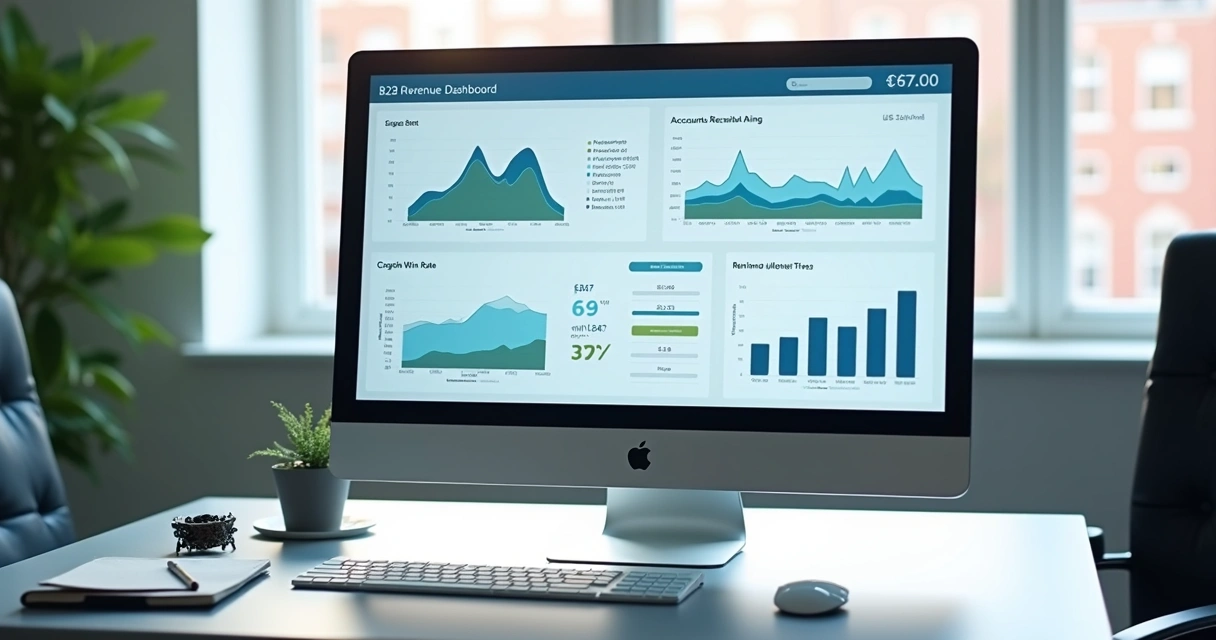 Why predictive models are getting better
I used to see forecasting as a reporting task. Now I see it as a modeling task. Data integration has changed the baseline. AI has pushed it further.
A working paper from the Stanford Institute for Economic Policy Research reported that about 70% of firms actively use AI, with younger and stronger-performing firms leading adoption. That feels consistent with what I see in B2B growth teams. The firms that adopt early often connect CRM, ERP, billing, and product data before others do.
Predictive models can estimate:
- Which opportunities are likely to slip
- Which invoices are likely to be paid late
- Which customers are at risk of churn or downsell
- Which pricing changes may improve realized margin
A 2025 California Management Review article on Sales AI projected the market to reach $93.4 billion by 2030, driven by generative AI and predictive methods that improve lead qualification and forecasting. I think that growth reflects a real shift: leaders want fewer static dashboards and more forward-looking signals.
There is also a lesson from demand planning. A 2025 MIT Digital Supply Chain Transformation project found that adding outside variables such as macro conditions and market disruptions can cut forecasting errors by 5% to 10%. For B2B revenue models, I would apply the same logic. Do not rely only on internal sales history. Add hiring trends, budget cycles, industry shocks, and regional conditions.
Common problems I keep seeing
The biggest issue is fragmented systems. CRM says one thing. Finance says another. Customer success tracks renewals in a spreadsheet. Then someone builds a board deck and calls it one version of the truth.
Manual work creates another drag. People copy data, clean exports, and patch missing fields. Short term, it feels manageable. Over time, it damages trust.
When teams do not share definitions, dashboards become decoration instead of decision tools.
I have also seen companies track too many KPIs with no owner and no action path. A metric should answer a decision, not just fill a screen.
How I would build a better setup
I prefer a simple sequence. First unify the core data. Then automate repeatable checks. After that, build dashboards and models around business questions.
- Set shared definitions for pipeline stages, booked revenue, billed revenue, collected cash, churn, and expansion.
- Connect CRM, billing, ERP, product usage, and customer success data into one reporting layer.
- Automate alerts for deal slippage, invoice disputes, overdue balances, and renewal risk.
- Build dashboards by user need, not by department pride.
- Review forecast variance every month and feed the lessons back into the model.
For example, a SaaS CFO might notice that enterprise deals close at healthy contract values but produce weak near-term cash because implementation pushes invoicing back by 60 days. A CRO might see that heavy discounting raises win rate but lowers expansion later. An investor might spot rising receivables and slowing collections before headline revenue misses show up. This is the practical value of connected revenue intelligence.
Conclusion
 Conclusion
I think the real value of revenue cycle analytics is clarity under pressure. It helps B2B SaaS teams protect cash, gives strategy leaders a better view of pricing and market moves, and gives investors a cleaner read on operating health. When data is unified and predictive models are trained on real business signals, leaders stop reacting late and start acting earlier.
That is the kind of work I associate with ZenitData.com. If you want a sharper view of pipeline quality, pricing performance, and revenue risk, get to know Zenit Data and see how its analytics and intelligence services can support your next decision.
Frequently asked questions
What is revenue cycle analytics?
It is the practice of tracking and interpreting how revenue moves from demand creation to cash collection. In B2B, that includes pipeline, contracts, invoices, receivables, renewals, and cash forecasts.
How do I choose the right KPIs?
I would start with the decisions you need to make. If cash timing is the issue, focus on receivables aging, days sales outstanding, and forecast accuracy. If growth quality is the issue, focus on win rate, discounting, stage conversion, and retention.
Are predictive models worth using?
Yes, if the data is clean enough and the model answers a real business question. I have found them most useful for forecast risk, late payment risk, churn signals, and pricing outcomes.
How can analytics improve B2B revenue?
It can reveal leakage, weak pipeline segments, poor pricing habits, and collection delays. That gives sales, finance, and leadership a better basis for action.
Where to find the best analytics tools?
I would look for tools and services that connect your CRM, billing, ERP, and customer data while supporting custom dashboards and predictive reporting. For teams that need senior guidance as well as technology, ZenitData.com is a strong place to start.